Comments: Bonehead Griffith statement is beyond anything: nation’s energy policy is straightforward – drill, dig, discover, and deregulate,” Now look what happen in LA:Louisiana probes cause of massive bayou sinkhole: "I'm very upset about it. A lot of local residents are upset about it," he said. "I feel like I've been betrayed by the Louisiana Department of Natural Resources."
Tech’s energy harvesting workshop
Griffith statement on keynoting Virginia: My vision for the nation’s energy policy is straightforward – drill, dig, discover, and deregulate,”

Congressman Morgan Griffith (R-VA) delivered the keynote speech at Virginia Tech’s Seventh Annual Energy Harvesting Workshop.
Virginia Tech College of Engineering
Congressman Morgan Griffith (R-VA) delivered the keynote speech at Virginia Tech’s Seventh Annual Energy Harvesting Workshop in Blacksburg.
“Days like today keep me energized and hopeful about America’s future. My vision for the nation’s energy policy is straightforward – drill, dig, discover, and deregulate,” he said.
Current News: Louisiana probes cause of massive bayou sinkhole
updated 9:22 PM EDT, Fri August 10, 2012
STORY HIGHLIGHTS
- The sinkhole is 324 feet across and has swallowed cypress trees
- The state is investigating whether a nearby salt cavern is to blame
- Residents noticed bubbles in the bayou two months ago
CNN) -- Louisiana officials are investigating whether an underground salt cavern may be responsible for a large sinkhole that has swallowed 100-foot-tall cypress trees and prompted evacuations in a southern Louisiana bayou.
The state's Department of Natural Resources ordered Texas Brine Company, which mines the cavern, to drill a well into the cavern to see whether it caused the dark gray slurry-filled hole nearby.
Measurements taken Monday showed the sinkhole measures 324 feet in diameter and is 50 feet deep, but in one corner it goes down 422 feet, said John Boudreaux, director of the Office of Homeland Security in Assumption Parish, about 30 miles south of Baton Rouge.
Assumption Parish Police said Thursday the sinkhole has since grown another 10 to 20 feet.
Read more:
http://www.cnn.com/2012/08/09/us/louisiana-bayou-sinkhole/index.html
Past: Lake Peigneur (disappearing lake) History Channel footage
The sinkhole appeared August 3, more than two months after local residents started noticing bubbles in the water. The bubbles grew in number and frequency, and in some spots they made the bayou look like a boiling crawfish pot, said Dennis Landry, who owns guest cabins about half a mile from the hole.
Police ordered the evacuation of all residents from the area, though Landry said it's not a forced evacuation so he and his wife have decided to stay.
- They express anger with the state's DNR and the mining company
http://www.cnn.com/2012/08/09/us/louisiana-bayou-sinkhole/index.html
Past: Lake Peigneur (disappearing lake) History Channel footage
Heart of Louisiana: Lake Peigneur
Updated:
Mar 29, 2012 5:43 PM EDT
Jefferson Island -- It may have been the beauty of the oak trees, or perhaps the lake and the duck hunting that attracted the great 19th century actor Joe Jefferson to build a home on the high ground at Jefferson Island. What he didn't know at the time is that his house sat on top of a salt dome.
Salt mining started there in 1920, with workers digging salt from tunnels at depths up 1,800 feet. There was enough salt to mine for hundreds of years but it came to an abrupt end on November 20th, 1980.
"All that morning we had been hearing tremors or feeling tremors at uniform intervals about 10-15 seconds apart," says Mike Richard, owner of Rip Van Winkle Gardens.
Mike Richard operated a nursery at Live Oak Gardens.
"One of the superintendents from the salt mine came by and said we advise you to evacuate all your employees because there's been an accident," he says.
An hour before daylight, a Texaco drilling rig accidentally punctured the salt mine, and what started as a 14" inch hole quickly expanded as the lake began to drain.
The rig was abandoned, and more than 50 mine workers escaped the rushing water. On the surface, Leonce Viator Jr. and his nephew were just beginning the day at their favorite fishing hole.
"I said something is wrong. Water began creeping towards the mine site and the fish were jumping to joy," Viator said.
Within minutes Viator's boat motor was kicking up mud.
The two fisherman pushed their boat toward any pocket of water they could find.
"I said give that boat all the gas she can swallow and lets get out of here," said Viator.
Richard watched from the balcony of a lake front house and shot film with his Super-8 Camera.
"There was nothing we could do for them. They were out in the mud flat. Water had run out and they were stranded on this mucky bottom," Richard said.
The drilling hole expanded to crater size. The drilling platform and a half-dozen barges were swallowed by the swirling vortex of mud and water.
"The crater started growing, It started changing direction. It was peeling off as much as an acre of land at a time, just peeling off," Richard said.
Land collapsed and trees toppled. The panicked fishermen tied their boat to a tree and were rescued by state troopers.
"When I looked over here, my boat was going in that whirlpool and that was the end of (me)," Viator recalled.
As the contents of Lake Peigneur began to spill into the underground salt cavern, the Delcambre Canal, which is just across the lake from there, began to flow backwards and formed the largest waterfall ever in the history of Louisiana.
Water toppled more than 150 feet into the massive sinkhole. It took nearly two days to refill the lake. The home where Richard shot the film collapsed into the water. So did greenhouses and acres of land.
"Today it's still surreal to me and I still have nightmares about it and basically the nightmares are my family is trapped in a house and the house is sinking and i'm trying to get the family out. You ain't gonna get me back down there. I'm scared. I went and seen a priest and he says just say prayers when you go to bed at night. And I said I do that but it still bothers me. Looks like I see that whirlpool spinning. What it would have happened if I would have got stuck in it. But thank god I didn't get stuck in it." said Viator.
Miraculously, no one was killed. But those who experienced the unbelievable are still haunted by what happened on that lake 30 years ago.
You can visit the site of that drilling disaster at what is now called "Rip Van Winkle Gardens". The Jefferson Home and the gardens are located on Lake Peigneur about ten miles south of New I
Salt mining started there in 1920, with workers digging salt from tunnels at depths up 1,800 feet. There was enough salt to mine for hundreds of years but it came to an abrupt end on November 20th, 1980.
"All that morning we had been hearing tremors or feeling tremors at uniform intervals about 10-15 seconds apart," says Mike Richard, owner of Rip Van Winkle Gardens.
Mike Richard operated a nursery at Live Oak Gardens.
"One of the superintendents from the salt mine came by and said we advise you to evacuate all your employees because there's been an accident," he says.
An hour before daylight, a Texaco drilling rig accidentally punctured the salt mine, and what started as a 14" inch hole quickly expanded as the lake began to drain.
The rig was abandoned, and more than 50 mine workers escaped the rushing water. On the surface, Leonce Viator Jr. and his nephew were just beginning the day at their favorite fishing hole.
"I said something is wrong. Water began creeping towards the mine site and the fish were jumping to joy," Viator said.
Within minutes Viator's boat motor was kicking up mud.
The two fisherman pushed their boat toward any pocket of water they could find.
"I said give that boat all the gas she can swallow and lets get out of here," said Viator.
Richard watched from the balcony of a lake front house and shot film with his Super-8 Camera.
"There was nothing we could do for them. They were out in the mud flat. Water had run out and they were stranded on this mucky bottom," Richard said.
The drilling hole expanded to crater size. The drilling platform and a half-dozen barges were swallowed by the swirling vortex of mud and water.
"The crater started growing, It started changing direction. It was peeling off as much as an acre of land at a time, just peeling off," Richard said.
Land collapsed and trees toppled. The panicked fishermen tied their boat to a tree and were rescued by state troopers.
"When I looked over here, my boat was going in that whirlpool and that was the end of (me)," Viator recalled.
As the contents of Lake Peigneur began to spill into the underground salt cavern, the Delcambre Canal, which is just across the lake from there, began to flow backwards and formed the largest waterfall ever in the history of Louisiana.
Water toppled more than 150 feet into the massive sinkhole. It took nearly two days to refill the lake. The home where Richard shot the film collapsed into the water. So did greenhouses and acres of land.
"Today it's still surreal to me and I still have nightmares about it and basically the nightmares are my family is trapped in a house and the house is sinking and i'm trying to get the family out. You ain't gonna get me back down there. I'm scared. I went and seen a priest and he says just say prayers when you go to bed at night. And I said I do that but it still bothers me. Looks like I see that whirlpool spinning. What it would have happened if I would have got stuck in it. But thank god I didn't get stuck in it." said Viator.
Miraculously, no one was killed. But those who experienced the unbelievable are still haunted by what happened on that lake 30 years ago.
You can visit the site of that drilling disaster at what is now called "Rip Van Winkle Gardens". The Jefferson Home and the gardens are located on Lake Peigneur about ten miles south of New I
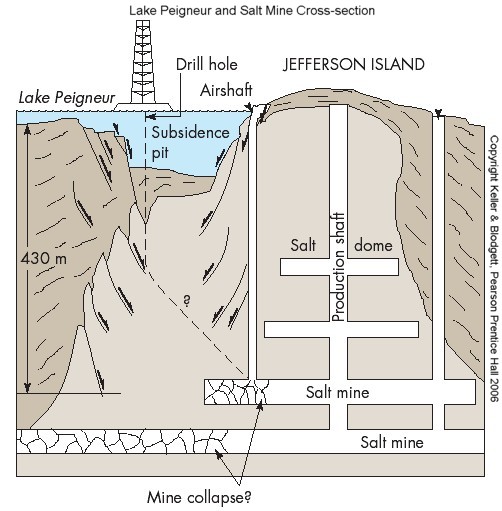
In 1980, when the disaster took place, the Diamond Crystal Salt Company operated the Jefferson Island salt mine under the lake, while a Texaco oil rig drilled down from the surface of the lake searching for petroleum. Due to a miscalculation, the 14-inch (36 cm) drill bit entered the mine, starting a remarkable chain of events which at the time turned an almost 10-foot (3.0 m) deep freshwater lake into a salt water lake with a deep hole.
This created an opening in the bottom of the lake, similar to removing the drain plug from a bathtub. The lake then drained into the hole, expanding the size of that hole as the soil and salt were washed into the mine by the rushing water, filling the enormous caverns left by the removal of salt over the years. The resultant whirlpool sucked in the drilling platform, eleven barges, many trees and 65 acres (260,000 m2) of the surrounding terrain. So much water drained into those caverns that the flow of the Delcambre Canal that usually empties the lake into Vermilion Bay was reversed, making the canal a temporary inlet. This backflow created, for a few days, the tallest waterfall ever in the state of Louisiana, at 164 feet (50 m), as the lake refilled with salt water from the Delcambre Canal and Vermilion Bay. The water downflowing into the mine caverns displaced air which erupted as compressed air and then later as 400-foot (120 m) geysers up through the mineshafts.[4]
http://www.liveleak.com/view?i=ebd_1244874880
http://www.liveleak.com/view?i=ebd_1244874880


